


Have you ever left a Human Design reading buzzing with insight but still wondered why your patterns keep repeating? Or read your Destiny Matrix report and thought, “That makes sense—but how do I work with it day‑to‑day?” You’re not alone. These two popular self‑discovery tools come from different traditions, yet they complement each other beautifully. In this article we’ll chat about the big differences, explore where they overlap, and weave in some real‑life analogies so you can see how Human Design and the Destiny Matrix play together in your career, relationships and personal growth.
Meet the Destiny Matrix: your life’s blueprint
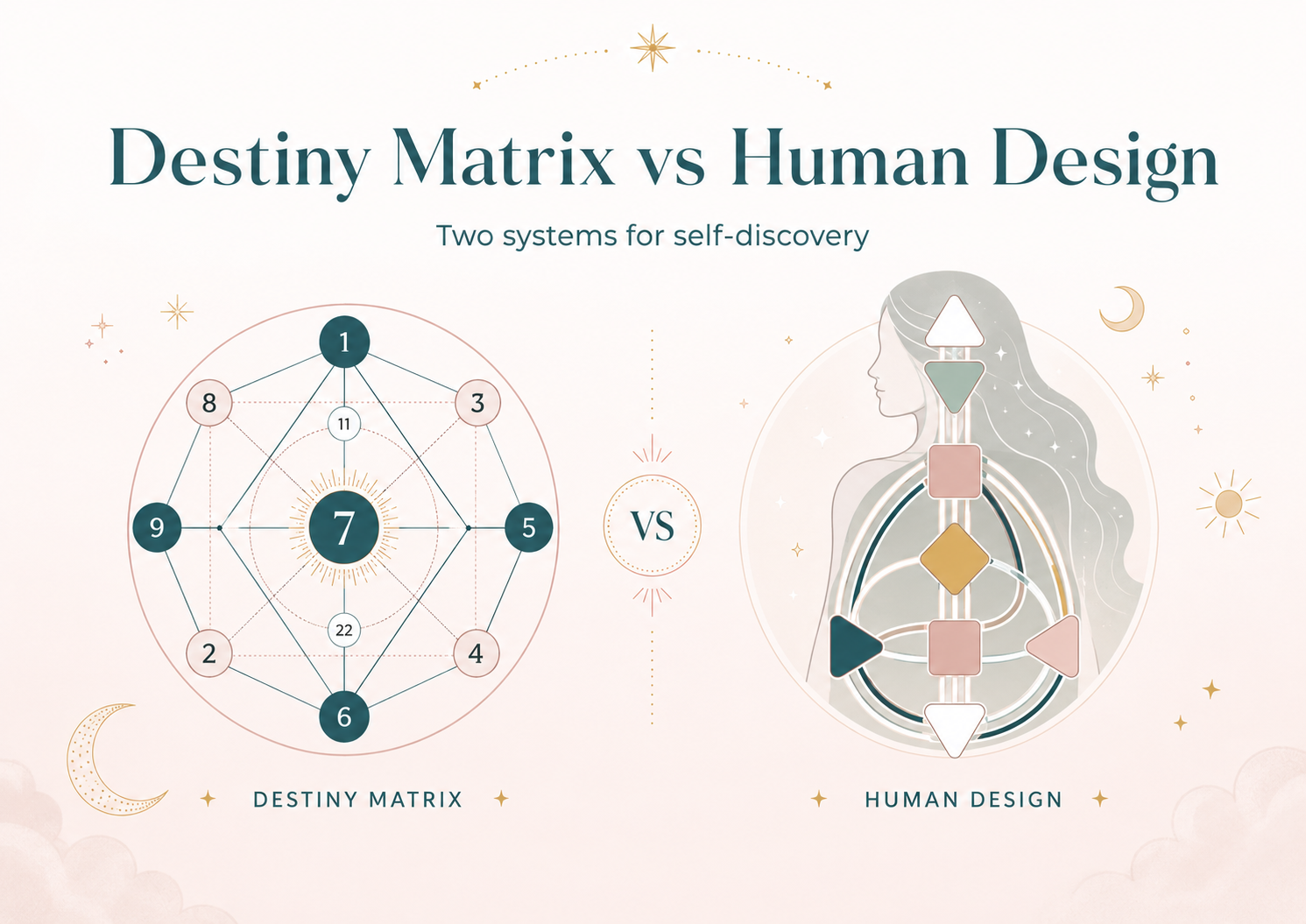
The Destiny Matrix is a numerology‑based system using your birth date to assign 22 archetypal energies—called Arcana—to different parts of your life. Some of its key features include:
- Central Arcana (Inner Self): This is your “behind‑the‑scenes” energy—who you are when no one’s watching. It’s calculated from your day, month and year combined, and people often feel deeply aligned with it. Think of it as the heartbeat of your chart.
- Portrait Zone: Imagine the way people describe you in three words—that’s your Portrait. It’s simply the number of your birth day (or its sum if you were born after the 22nd) and represents the first impression you give to the world. Someone with Arcana 3 here might come across as naturally stylish; Arcana 1 gives off a leader vibe.
- Money Line: Drawn between certain positions in the matrix, this line shows how you relate to resources and financial flow. A plus state here suggests ease and generosity; a minus state can signal fears or unhelpful habits around money.
- Karmic Tail: This position hints at old patterns and ancestral lessons you’ve inherited. It can feel like a hidden program running in the background—once you see it, you can decide whether to keep or rewrite it.
Meet Human Design: your user’s manual
Human Design blends astrology, the I Ching, the chakra system and Kabbalah. To build your bodygraph you need your exact birth time, date and location, because even small shifts can change your design. Key ingredients are:
- Type (Manifestor, Generator, Manifesting Generator, Projector or Reflector), which describes how your energy operates.
- Strategy and Authority, which act like signposts and decision‑making tools. For example, Generators are designed to respond, while Projectors thrive when invited.
- Centers (nine energy hubs) and Channels/Gates, which show where you’re consistent (defined) or more influenced by your environment (undefined). Your Profile (e.g. 3/5, 4/6) describes the role you tend to play in life.
Comparing key pieces
Below are a few parallels between the Destiny Matrix and Human Design. These aren’t exact matches but rather bridges to help you make sense of both systems together. If a comparison doesn’t resonate for you, it’s okay—use what feels useful and let the rest go.
Central Arcana vs. the G Center and Profile
Your Central Arcana reveals your inner landscape—similar to how the G Center in Human Design governs identity and direction. If your Central Arcana is 11 (Strength), you might feel a steady inner will and desire to master challenges. Someone with a defined G Center will recognise a consistent sense of self. Meanwhile, your Profile (such as 2/4 or 5/1) describes how others perceive you and the life themes you play out, which echoes the Destiny Matrix’s Portrait Zone: both speak to the roles you naturally inhabit.
Portrait Zone vs. Personality Sun and Conscious Lines
In the Destiny Matrix, the Portrait Zone is literally your birth day number. It shows how you initially appear to others. In Human Design, the Personality Sun gate (and the conscious line of your Profile) can similarly describe your outward personality. For example, someone with Gate 45 as their Personality Sun often has leadership over resources, while Arcana 4 in the Portrait zone signals a pragmatic, dependable persona. Both give you clues about the vibe you radiate before people know the deeper you.
Money Line vs. Ego/Will and Root Centers
Money in the Destiny Matrix is not just about cash; it’s about flow, self‑worth and generosity. In Human Design, the Ego/Will center governs willpower and material resources, while the Root center deals with pressure and drive. An empowered Money Line in the Matrix pairs well with a defined Ego center that knows its value. When the Money Line is in minus state (scarcity mindset), it can feel similar to an undefined Ego center seeking to prove itself. Awareness here helps you shift from proving to trusting your worth.
Karmic Tail vs. Nodes and Past Conditioning
The Karmic Tail holds lessons from past lives or ancestral patterns. Human Design doesn’t have a direct equivalent, but the Nodes of the Moon (North and South) indicate themes you’re moving away from and toward. Also, undefined centers in Human Design act like sponges for conditioning—much like karmic residue. If your Matrix shows a minus state Karmic Tail, it might be time to examine any not‑self behaviours that stem from past conditioning.
Career, relationships and personal growth: using both systems
Career
If you’re exploring your career, look to your Purpose Arcana (often Position 4 in the Destiny Matrix) and your Money Line. A plus state Arcana 10 (Wheel of Fortune) here might suggest opportunities come through networking and embracing change. In Human Design, check your Type and Authority: Generators should follow their gut response, while Manifestors thrive when they initiate what feels right. Combining both, you might decide to take a new job only after your sacral lights up and the career path aligns with your Purpose Arcana.
Relationships
For relationships, the Matrix’s Love Zone (Position 2) reveals the style of partnership that supports you. A minus state Arcana 15 (The Devil) could mean patterns of passion without commitment—an invitation to work on boundaries. In Human Design, pay attention to the Heart/Ego and G Center and how they interact in composite charts. An undefined Heart might lead you to prove your worth to partners; recognising this can help you choose more nourishing connections.
Personal growth
For personal growth, start with your Karmic Tail and any minus state positions in the Matrix. These are invitations to heal family patterns and release old stories. Human Design complements this by showing where you’re most conditioned (undefined centers) and how to decondition through Strategy and Authority. As you practise responding (Generators) or waiting for invitation (Projectors) while addressing your Karmic Tail, you’ll notice old habits shifting.
Is everything comparable? Not always—and that’s okay
You’ll notice that some pieces line up nicely and others don’t. That’s because the Destiny Matrix and Human Design were built from different philosophies. The Matrix leans heavily on numerology and the tarot’s Major Arcana. Human Design fuses the I Ching and astrology with quantum mechanics. Rather than forcing a perfect match, think of them as two friends offering different perspectives. Where there’s overlap (like central arcana and identity), use it. Where there isn’t (like karmic tail vs. will centre), honour that each system speaks its own language.
Final thought: two maps, one journey
At the end of the day, both the Destiny Matrix and Human Design invite you to live more consciously. One offers a map of themes (arcana, zones, karmic programs); the other gives you a vehicle manual (type, strategy, centres). You can choose one to start with or use both; they don’t cancel each other out. Your life is the experiment. The more tools you have, the more gracefully you can navigate the twists, turns and scenic routes of your unique path.