



Frugal chic isn’t about being “cheap.” It’s about being awake.
It’s the art of choosing well, buying less, and still looking and living with taste. It’s the quiet confidence of someone who doesn’t need to prove anything through a shopping cart. And underneath the outfits and Pinterest boards, frugal chic is really a mindset: intentional energy management.
That’s why frugal chic connects so naturally to mindful behavior… and to the Destiny Matrix as a tool for understanding your inner patterns, motivations, and life lessons.
Because here’s the truth: your style changes, your body changes, your address changes. But knowing yourself is timeless.
What “Frugal Chic” Really Means
Frugal chic is a modern cultural shift where people aim to:
- spend more consciously
- reduce impulse buying
- prioritize quality and versatility
- use secondhand, resale, vintage, swaps, and repairs
- look polished without overspending
It’s “I have taste” without “I have debt.”
In fashion, it often looks like capsule wardrobes, neutral palettes, classic silhouettes, and subtle elegance. In lifestyle, it shows up as fewer purchases, better choices, and a calm attitude toward “stuff.”
Frugal chic is not an aesthetic only. It’s a philosophy: beauty with boundaries.
Where Frugal Chic Came From (and Why It’s Back Again)
The phrase “frugal chic” has popped up during multiple eras of economic pressure, when society collectively realized:
overconsumption is exhausting.
Like many trends with long roots, it resurfaced strongly in recent years because:
- cost-of-living pressures make mindless spending less realistic
- resale and secondhand became mainstream (and even aspirational)
- “haul culture” started to feel empty for many people
- people began craving a lifestyle that feels stable, elegant, and calm
So frugal chic isn’t random. It’s a cultural correction. A pendulum swing back to:
Do I actually need this? Does it fit my real life?
That question alone is already mindfulness.
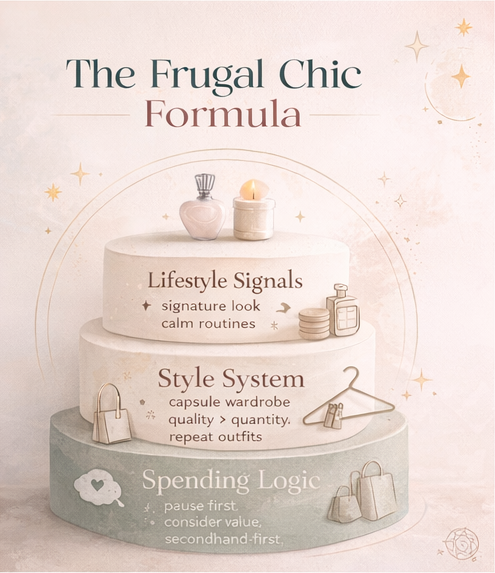
The Features of Frugal Chic (Style + Psychology)
Let’s make it practical. Frugal chic has recognizable “signals,” but they’re mostly about behavior.
Style features
- Timeless silhouettes: coats, tailored pieces, good shoes, clean lines
- Neutral or restrained color palettes (not always, but often)
- Minimal branding (or no branding at all)
- “Repeat outfits” confidence: re-wearing is normal, not embarrassing
- Mixing high-low: thrifted gems + simple basics
Behavior features
- Shopping is strategic, not emotional
- You can explain every purchase (why it’s worth it, how you’ll use it)
- Quality over quantity
- Value awareness: cost-per-wear, longevity, resale potential
- Waiting is normal: you don’t buy instantly just because something sparkles
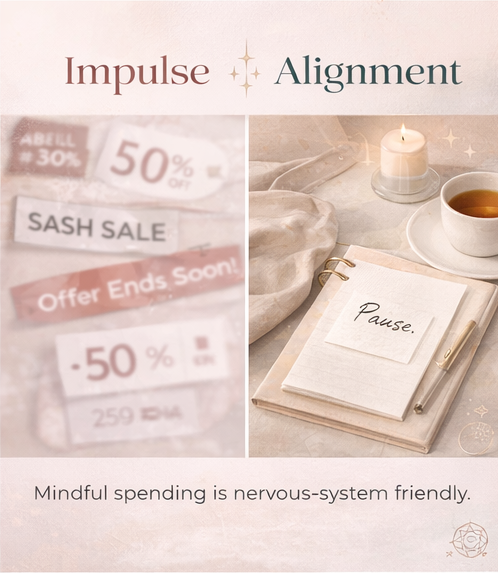
In other words: frugal chic is the ability to pause.
And pausing is power.
The Mindful Core: Frugal Chic as Attention Training
Mindfulness isn’t only meditation candles and ocean sounds. Mindfulness is also:
- noticing your impulses
- observing your emotional triggers
- choosing your actions instead of reacting
- respecting your resources: time, money, energy, attention
Frugal chic trains exactly that.
When you don’t buy something immediately, you practice emotional regulation.
When you choose fewer, better items, you practice clarity.
When you stop shopping as entertainment, you practice presence.
That’s why frugal chic can feel… unexpectedly healing.
Because it shifts the question from “What can I get?” to “What am I building?”
The Shadow Side: The Pros and Cons (Global Perspective)
Frugal chic has real benefits, but it also has pitfalls. Let’s be honest.
Pros
- Financial stability: less waste, fewer regrets
- Less clutter, more calm: your home and mind feel lighter
- Sustainability: reuse culture reduces demand for constant new production
- Self-trust grows: you prove you can choose wisely
- Style becomes personal: less trend-chasing, more identity
Cons
- Time privilege: thrifting well, reselling, tailoring, deal-hunting takes time
- Moral superiority trap: “I’m mindful and others are foolish” energy is not it
- Hidden class signaling: minimalism can still be status, just quieter
- Aestheticizing struggle: for some people, frugality isn’t a choice, it’s survival
Globally, frugal chic means different things depending on the country and economy. In some places, it’s a trendy label for something older generations have always done. In others, it’s a response to inflation and uncertainty. But the core pattern stays consistent:
The future feels unstable, so people seek control through choices.
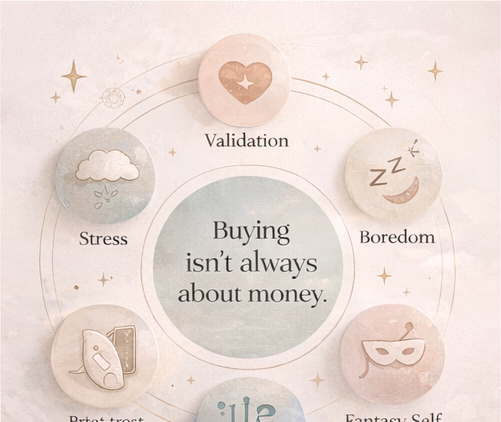
The Destiny Matrix Connection: Why We Spend the Way We Spend
Here’s the interesting part.
Most people think spending is about money. But spending is also about:
- identity
- emotional needs
- belonging
- anxiety regulation
- control
- self-worth
- coping mechanisms
That’s why two people can earn the same amount and live totally different realities. Because money behavior is rarely only logical.
In the Destiny Matrix, every person carries a unique configuration of energies and lessons. And those energies often show up in very practical places: how you:
- handle pleasure vs. discipline
- seek comfort or status
- deal with uncertainty
- chase novelty or avoid change
- respond to stress
- build stability
- express love and beauty
So frugal chic can become more than a trend for you. It can be a mirror.
A few reflective prompts (Destiny Matrix style)
When you feel the impulse to buy something, ask:
- What am I hoping this purchase will give me emotionally?
- Is this aligned with who I’m becoming, or who I’m trying to impress?
- Does this support my long-term path or distract me from it?
- Am I buying to soothe stress, boredom, loneliness, or uncertainty?
- What part of me is speaking right now: the soul or the nervous system?
Frugal chic, at its best, isn’t restriction. It’s alignment.
And alignment is one of the most spiritual things you can practice in daily life.
Frugal Chic, But for Your Soul: The Timeless Investment
Let’s zoom out.
A coat wears out.
A trend expires.
Even the most beautiful “perfect item” eventually becomes… just an item.
But self-knowledge compounds.
When you invest in understanding yourself, you gain:
- clearer decisions
- better relationships
- stronger boundaries
- healthier money patterns
- more accurate intuition
- less self-sabotage
- deeper sense of direction
This is why learning your Destiny Matrix is a timeless investment.
Not because it’s mystical decoration.
Because it helps you decode the pattern behind your choices.
“Frugal chic” is selective spending.
“Soul chic” is selective living.
Both are about choosing what matters, and letting the rest go.

The Real Trend of Our Time: Conscious Choice
Frugal chic is popular because it answers a modern hunger:
People want to feel elegant, stable, and in control again.
But the deepest kind of stability isn’t found in a perfect wardrobe.
It’s found in knowing:
- what drives you
- what drains you
- what you truly want
- what lessons repeat in your life
- what kind of love you’re built to give and receive
- what success actually means for you
That’s why investing in your inner world is always in style.
Trends come and go.
But self-awareness is forever.
Want to Go Deeper?
If you’re curious how your personality patterns influence your choices, relationships, and life direction, your Destiny Matrix can give you a structured, practical mirror.
Not to “predict” your life like a magic trick.
But to help you understand yourself with more clarity, compassion, and strategy.
Because the most timeless luxury isn’t a label.
It’s inner alignment.